THE BENEFITS OF PAIRING VITAMIN C WITH SPF.
BARRIER BOOSTING BUNDLE
$587 | 120 Active Daily Doses
BARRIER BOOSTING BUNDLE
$587 | 120 Active Daily Doses
We know that SPF is, or should be, the cornerstone of any morning skincare routine. But there is one product pairing that can help elevate your sun protection from average to exceptional.
Vitamin C and SPF, when layered together, can work in synergy to address UV damage. One is neutralizing free radicals while the other filters radiation. Here’s the science behind this combo, and how to make it work for your skin.
Vitamin C (or, more scientifically, L-ascorbic Acid) is one of the most researched actives in skincare. It is a potent antioxidant that neutralizes free radicals, supports collagen synthesis, and visibly brightens uneven skin tone with consistent use.
Crucially, it also plays a direct role in the skin's defense against UV-induced oxidative stress, making it far more than just a brightening ingredient.

Sunscreen is essential, but unfortunately, it isn’t foolproof. Even the most diligent SPF application will filter UV radiation rather than block it entirely. There are also limits to its defense against free radicals that UV exposure will inevitably generate within the skin1 .This is where antioxidant support becomes not just complementary, but necessary.
When Vitamin C and SPF are used together, their protective benefits compound in ways that neither product could achieve on their own. A landmark study published in the Journal of the American Academy of Dermatology found that the combination of a topical antioxidant and sunscreen provided significantly greater protection against UV-induced skin damage than sunscreen alone2.
Vitamin C works by scavenging the free radicals that penetrate past SPF's filtration, neutralizing oxidative damage at a cellular level before it can degrade collagen, disrupt melanin production, or accelerate photoaging3.
The relationship is reciprocal, too. Research suggests that Vitamin C may help extend the efficacy of sunscreen by reducing photodegradation; the process by which UV exposure breaks down SPF actives over time4. In short, each ingredient helps the other perform better.
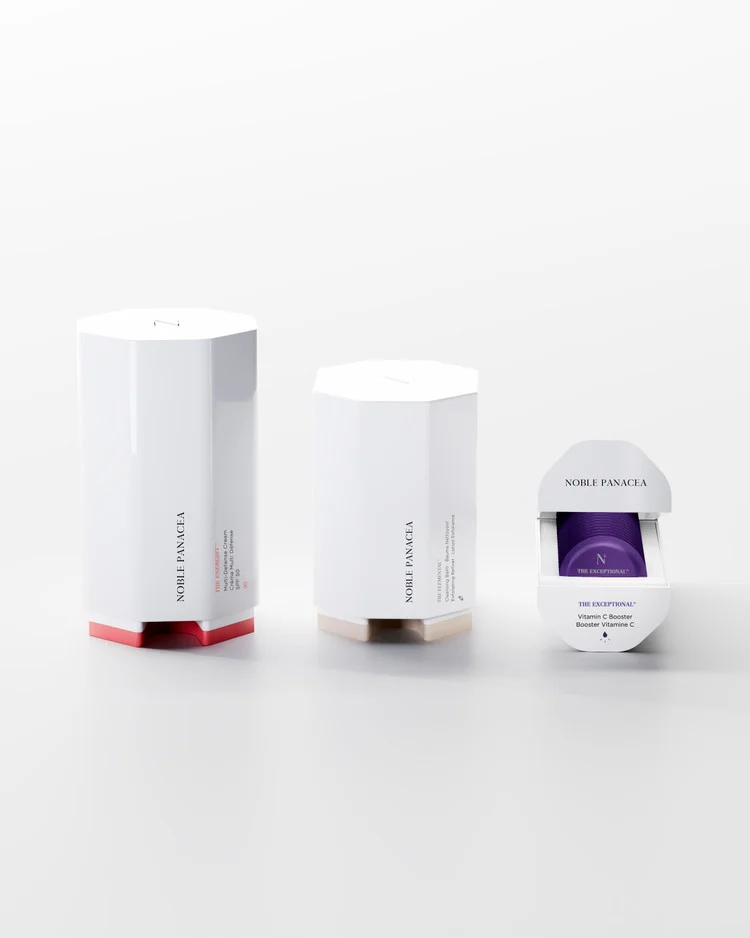
As always, the order of application matters. Your Vitamin C serum should always be applied first, directly onto cleansed skin, and allow for it to fully absorb before SPF is layered on top. This ensures the antioxidant is positioned within the skin where it can intercept free radicals, while SPF sits on the surface to filter incoming UV rays.
Avoid formulations that combine both ingredients in a single product, the stability of Vitamin C can be compromised when mixed directly with SPF filters, ultimately reducing the efficacy of both5.
Prevention is the most powerful tool against anti-aging. Consistent, daily use of Vitamin C and broad-spectrum SPF can help to improve skin tone and texture, as well as reduce fine lines.
1. Diffey, B.L. (2001). When should sunscreen be reapplied? Journal of the American Academy of Dermatology, 45(6), 882–885.
2. Lin, F.H., Lin, J.Y., Gupta, R.D., et al. (2003). Ferulic acid stabilizes a solution of vitamins C and E and doubles its photoprotection of skin. Journal of Investigative Dermatology, 125(4), 826–832.
3. Pinnell, S.R. (2003). Cutaneous photodamage, oxidative stress, and topical antioxidant protection. Journal of the American Academy of Dermatology, 48(1), 1–19.
4. Burke, K.E. (2007). Interaction of vitamins C and E as better cosmeceuticals. Dermatologic Therapy, 20(5), 314–321.
5. Telang, P.S. (2013). Vitamin C in dermatology. Indian Dermatology Online Journal, 4(2), 143–146.
LES COLLECTIONS



'%3E%3Cpath d='M0 0H360V240H0V0Z' fill='%23A1A8C2' fill-opacity='0.18'/%3E%3Cpath d='M260 59C260 78.33 244.33 94 225 94C205.67 94 190 78.33 190 59C190 39.67 205.67 24 225 24C244.33 24 260 39.67 260 59Z' fill='%23A1A8C2' fill-opacity='0.25'/%3E%3Cpath fill-rule='evenodd' clip-rule='evenodd' d='M319 250H417L291.485 124.485C286.799 119.799 279.201 119.799 274.515 124.485L234 165L319 250Z' fill='%23A1A8C2' fill-opacity='0.25'/%3E%3Cpath d='M311 250L-89 250L102.515 58.4853C107.201 53.799 114.799 53.799 119.485 58.4853L311 250Z' fill='%23A1A8C2' fill-opacity='0.25'/%3E%3C/g%3E%3Cdefs%3E%3CclipPath id='clip0'%3E%3Cpath d='M0 0H360V240H0V0Z' fill='white'/%3E%3C/clipPath%3E%3C/defs%3E%3C/svg%3E%0A)