UNDERSTANDING VITAMIN A: RETINOL VS RETINAL
There’s a reason Vitamin A tends to act as an anchor for every ‘serious’ skincare ritual; it is a non-negotiable active ingredient for anyone who is hyper focused on building a skin barrier that is as resilient as it is luminous.
Decades of dermatological research have revealed Vitamin A’s unmatched ability to support collagen synthesis, refine skin texture, and accelerate cell renewal. But it is not just one ingredient, it’s a whole family of compounds each with a distinct role to play, and a rather distinct (irritating) reaction.
Retinol and retinal are two of the most celebrated derivatives and knowing how they differ will help to decide what your skin needs.
What Is Retinol?
Retinol is the most established member of the retinoid family, and typically the first form of Vitamin A that people introduce into their skincare routine. No matter the format (a serum, a cream, an ointment), once retinol is applied and absorbed into the skin, it will naturally undergo two sequential conversions before it becomes retinoic acid. This is the biologically active and final form of retinoids that skin can use to drive visible and structural changes.
Retinol’s gradual two-step conversion means it is well tolerated among frequent users. The results are much more cumulative, rather than an abrupt transformation.
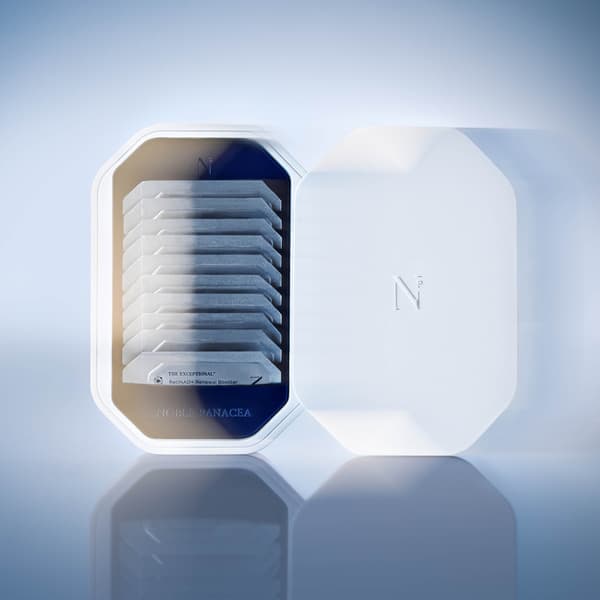
RETINAD+ RENEWAL BOOSTER
$240 | 10 Active Daily Doses


.jpeg&w=3840&q=75)



.webp&w=640&q=75)
.webp&w=640&q=75)
.webp&w=640&q=75)
.webp&w=640&q=75)
.webp&w=640&q=75)
.webp&w=640&q=75)

.webp&w=640&q=75)

.webp&w=640&q=75)



.webp&w=640&q=75)


.jpeg&w=640&q=75)



'%3E%3Cpath d='M0 0H360V240H0V0Z' fill='%23A1A8C2' fill-opacity='0.18'/%3E%3Cpath d='M260 59C260 78.33 244.33 94 225 94C205.67 94 190 78.33 190 59C190 39.67 205.67 24 225 24C244.33 24 260 39.67 260 59Z' fill='%23A1A8C2' fill-opacity='0.25'/%3E%3Cpath fill-rule='evenodd' clip-rule='evenodd' d='M319 250H417L291.485 124.485C286.799 119.799 279.201 119.799 274.515 124.485L234 165L319 250Z' fill='%23A1A8C2' fill-opacity='0.25'/%3E%3Cpath d='M311 250L-89 250L102.515 58.4853C107.201 53.799 114.799 53.799 119.485 58.4853L311 250Z' fill='%23A1A8C2' fill-opacity='0.25'/%3E%3C/g%3E%3Cdefs%3E%3CclipPath id='clip0'%3E%3Cpath d='M0 0H360V240H0V0Z' fill='white'/%3E%3C/clipPath%3E%3C/defs%3E%3C/svg%3E%0A)

